

 Aqua therapy, also known as “aquatic physical therapy” and “hydrotherapy,” is an evidence-based practice aimed at helping patients with a wide variety of conditions. As with other forms of physical therapy, aqua therapy involves:
- Oversight of a licensed practitioner and
- Adherence to an individualized plan of care
Aquatic physical therapy should be used in addition to other therapies, such as physical and occupational therapy. The unique properties of water and the ways in which it influences movement can provide certain benefits that traditional physical therapy may not.
What does aqua therapy look like?
Aqua therapy typically takes place in a swimming pool. The Academy of Aquatic Physical Therapy (APTA) provides exact regulations regarding the operation and maintenance of these pools, presence of lifeguards and other safety features. These rules may vary according to state and local laws. In some cases, aqua therapy is given in a group setting to patients with a range of different disabilities/conditions. In others circumstances, it may be more individualized or a one-on-one session.
How does aqua therapy work?
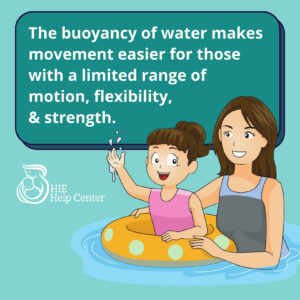 Patients who may have more difficulty exercising on land benefit from the buoyancy of water, which can make movement easier for those with limited flexibility, range of motion, and strength.
Hydrostatic pressure can also provide numerous benefits: it helps:
- Improve circulation
- Decreases pain
- Increases range of motion and
- Can have calming effects
Moreover, water provides has a high viscosity, which can make certain types of movement more challenging and help to increase muscle tone and cardiovascular fitness.
Brainline explains that, “The higher viscosity of water makes muscles work harder when compared to the same exercises on land. Viscosity can be described as the way the water molecules stick together when you try to move through them. It is harder to move through the water than it is to move on land because the water molecules are sticking to each other and to you.”
 What are the benefits of aqua therapy?
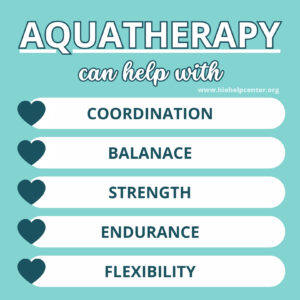
Aqua therapy can help to maintain or improve the following, among other benefits:
- Coordination
- Balance
- Posture
- Flexibility
- Strength
- Endurance
- Heart and lung function
- Relaxation
What kinds of conditions can aqua therapy help with?
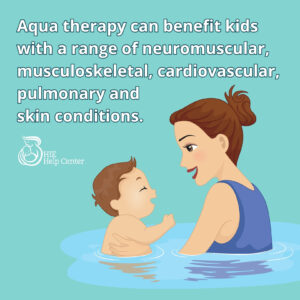
Aqua therapy can benefit those with a wide range of neuromuscular, musculoskeletal, cardiovascular, pulmonary, and integumentary (skin) conditions, among others. It can also help those with neurological conditions because being in the water minimizes involuntary spasticity and tremors. This type of therapy can also help with muscle reeducation: movements in the water tend to be slower, which gives the patient more time to process the ways their body is working.
How can aqua therapy help children with HIE and associated disabilities?
Aqua therapy can help to minimize negative symptoms and improve function in children with hypoxic ischemic encephalopathy (HIE) and associated conditions. In particular, children with cerebral palsy (CP) can benefit from aquatic physical therapy.
Aqua therapy may be especially helpful for children and adolescents with CP who are non-ambulatory and struggle with land-based physical activities. However, much of the research published thus far focuses on those with fairly minor impairments; therefore, it is difficult to draw conclusions about the effects of aqua therapy on those who are more severely affected by CP.
Does aqua therapy only help with physical disabilities?
 No, aqua therapy can be restorative in more ways than one! Recent research on people with cerebral palsy found that aquatic physical therapy can also improve emotional wellbeing, which suggests that this type of therapy may also be an effective intervention for mental health concerns.
About the HIE Help Center and ABC Law Centers
The HIE Help Center is run by ABC Law Centers, a medical malpractice firm exclusively handling cases involving HIE and other birth injuries since the firm’s inception in 1997.
If you suspect your child’s HIE may have been caused by medical negligence, please contact us today to learn more about pursuing a case. We provide free legal consultations, during which we will inform you of your legal options and answer any questions you have. Moreover, you would pay nothing throughout the entire legal process unless we obtain a favorable settlement.
You are also welcome to reach out to us with inquiries that are not related to malpractice. We cannot provide individualized medical advice, but we’re happy to track down informational resources for you.
Sources
- CaduceusWebs Co. (n.d.). Frequently Asked Questions in Aquatic Physical Therapy: AAPT. Retrieved October 24, 2019, from https://aquaticpt.org/faq.
- Why Aquatic Therapy? (2017, May 27). Retrieved November 8, 2019, from https://www.brainline.org/article/why-aquatic-therapy.
- Vo, S. D. P. T., Becnel, S. D. P. T., Salem, P. T., & Liu, P. T. (2016). Effectiveness of Aquatic Therapy Interventions in the Management of Children with Cerebral Palsy: A Systematic Review.
- Gorter, J. W., & Currie, S. J. (2011). Aquatic exercise programs for children and adolescents with cerebral palsy: What do we know and where do we go?. International journal of pediatrics, 2011.
- Ryu, K., Ali, A., Kwon, M., Lee, C., Kim, Y., Lee, G., & Kim, J. (2016). Effects of assisted aquatic movement and horseback riding therapies on emotion and brain activation in patients with cerebral palsy. Journal of physical therapy science, 28(12), 3283-3287.
Leave a Reply
You must be logged in to post a comment.